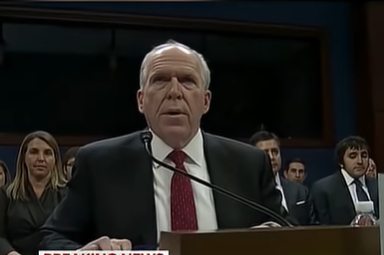
John Brennan, the former CIA Director who spent four years on cable news calling President Trump a traitor, has been subpoenaed to appear before a grand jury. Not a congressional hearing where he can grandstand and run out the clock. A grand jury. The kind where you answer questions under penalty of perjury.
Funny how the vocabulary changes when you're the one sitting in the chair.
The subpoena is part of what's being described as a "grand conspiracy" investigation targeting Trump's political opponents from the Obama era.
Brennan's tenure at CIA has been under scrutiny for years. This is the man who oversaw an intelligence apparatus that opened investigations into a presidential campaign based on opposition research funded by the opposing candidate's party. He then spent his post-government career collecting CNN paychecks while accusing a sitting president of treason — his word, not ours — on live television.
The Obama-era intelligence community operated with a level of political coordination that, if the grand jury finds what investigators appear to believe is there, would represent one of the most serious abuses of federal law enforcement power in modern American history. The investigation isn't targeting a single act but an alleged pattern — a conspiracy, in the legal sense — involving multiple officials across agencies.
The standard defense from Brennan's corner has always been that these investigations are "politically motivated." That's a remarkable objection coming from a man whose agency opened a counterintelligence investigation into a political rival of the administration he served. The grand jury doesn't care about cable news narratives. It cares about evidence, testimony, and whether the facts support criminal charges.
What makes this different from every previous round of "accountability is coming" talk is the mechanism. Congressional hearings produce soundbites. Inspector general reports produce footnotes. Grand juries produce indictments. Brennan isn't being asked to testify for the cameras. He's being compelled to testify under oath, behind closed doors, where his answers carry legal consequences.
Brennan spent years building a public persona as the righteous intelligence professional standing up to an illegitimate president. He wrote op-eds. He did the cable circuit. He called the commander-in-chief compromised by a foreign power without producing a shred of evidence that held up. The Mueller investigation came and went. The Senate Intelligence Committee came and went. And every time, the same conclusion: the foundation Brennan helped lay was built on sand.
Now someone with subpoena power wants to know exactly who knew what, when they knew it, and whether the actions taken crossed the line from political maneuvering into criminal conduct.
The man who spent years demanding everyone else answer for their relationship with Russia finally has to answer for his own relationship with the truth.