Iran tried to plant mines in the Strait of Hormuz. That's the chokepoint through which roughly 20% of the world's oil supply flows every day — a waterway so critical that mining it stops being a regional provocation and becomes an act of economic warfare against every country on Earth that runs on energy.
The mines are gone. So is some Iranian military hardware.
When U.S. forces struck Iran's minelaying operation near the Strait, Iran fired back — eight ballistic missiles aimed at King Hussein Air Base and Al-Azraq Air Base in Jordan. Jordan's air defenses knocked down all eight. Iran took two swings and connected on neither.
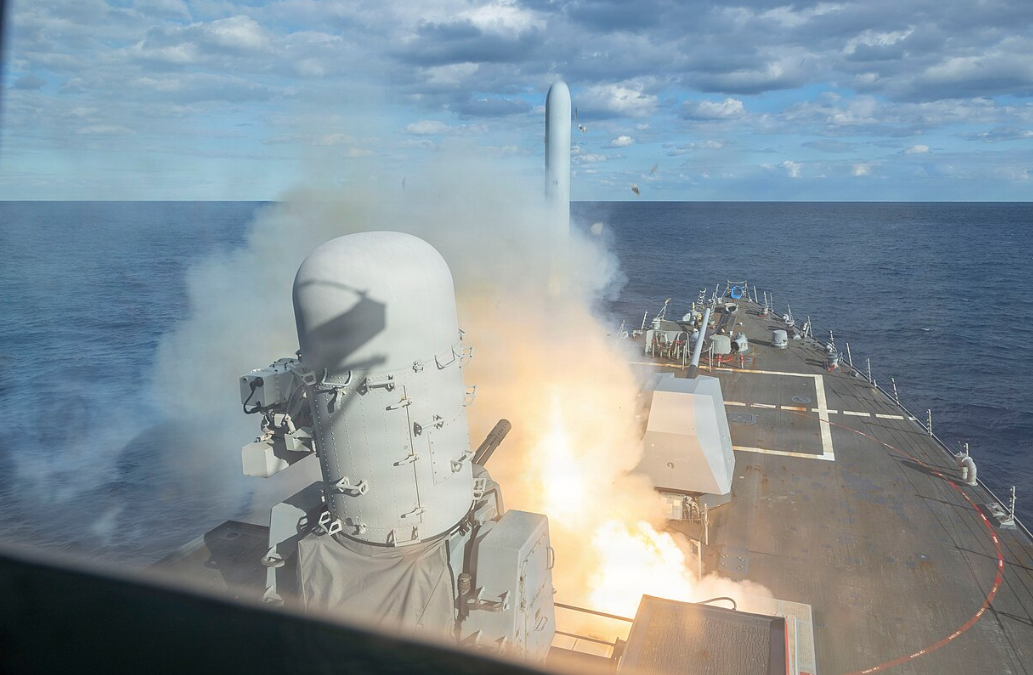
President Trump then announced Tuesday via Truth Social that the U.S. military had conducted massive retaliatory strikes against Iranian targets near the Strait of Hormuz. "The strikes are large and powerful," Trump wrote, "and in retaliation for the Iranians' failed attempt at adding sea mines to the Strait."
Failed being the operative word. The mines have been "completely removed or detonated." Every one of those eight missiles was "successfully knocked down." Iran launched a coordinated escalation against American military personnel and global shipping and came away with nothing — except U.S. strikes on their own territory.
Then Trump did something unusual.
He didn't just announce the retaliation. He announced what comes next. Any further Iranian response, he warned, would be met with strikes "at a much harder and higher level." An even larger attack, he added, was already "waiting in the wings."
He posted this on Truth Social. In public. Where Tehran's leadership could read it in real time.
A public pre-announcement of a larger strike, on the record, so Iran's government woke up Tuesday morning knowing exactly what the cost of their next move would be — and knowing that America knew they knew. That's psychological warfare conducted in the open, using a social media platform as the delivery mechanism.
Contrast this with the last two decades of American Iran policy. Barack Obama shipped $1.7 billion in cash — actual pallets of physical currency — to Tehran in 2016. Anyone paying attention recognized it as ransom dressed up as diplomacy. Joe Biden's approach was even less inspiring: he stood at podiums and said "don't" to adversaries who proceeded to do exactly what they wanted. Iran-backed proxies attacked U.S. forces dozens of times during the Biden years, and the responses ranged from tepid to nonexistent.
Trump's doctrine is simpler. You mine international waters, we remove the mines and blow up your ships. You fire eight missiles at our bases, we shoot them down and hit you harder. And if you're thinking about round three, there's a bigger strike already loaded.
Foreign policy analysts are already warning about "escalation" — as if four years of restraint produced anything other than more Iranian attacks on American personnel. It didn't moderate Tehran's behavior. It encouraged it. The results are in.
Every barrel of oil that transits the Strait of Hormuz touches gas prices from Houston to Hamburg. Iran wasn't just attacking American military personnel — they were threatening the wallets of every working family that fills up a tank, on every continent. The strike that removed those mines wasn't aggression. It was the minimum responsible answer to an attack on the global economy.
For forty years, Iran has operated on a simple calculation: attack American interests, absorb a few targeted sanctions, wait for the next administration. It worked. Carter, Reagan, Bush, Clinton, Bush, Obama, Biden — each one drew lines Iran learned to walk up to and occasionally cross. The price was always manageable.
Tuesday was a data point that breaks the formula.
American strikes on Iranian territory. Eight Iranian missiles shot out of the sky over Jordan. A public promise of larger strikes already prepared and waiting — delivered not through diplomatic back-channels but on a social media platform in plain language, so no one in Tehran could claim they didn't understand the terms.
Iran is learning, possibly for the first time in a generation, that American threats come with a delivery date.